


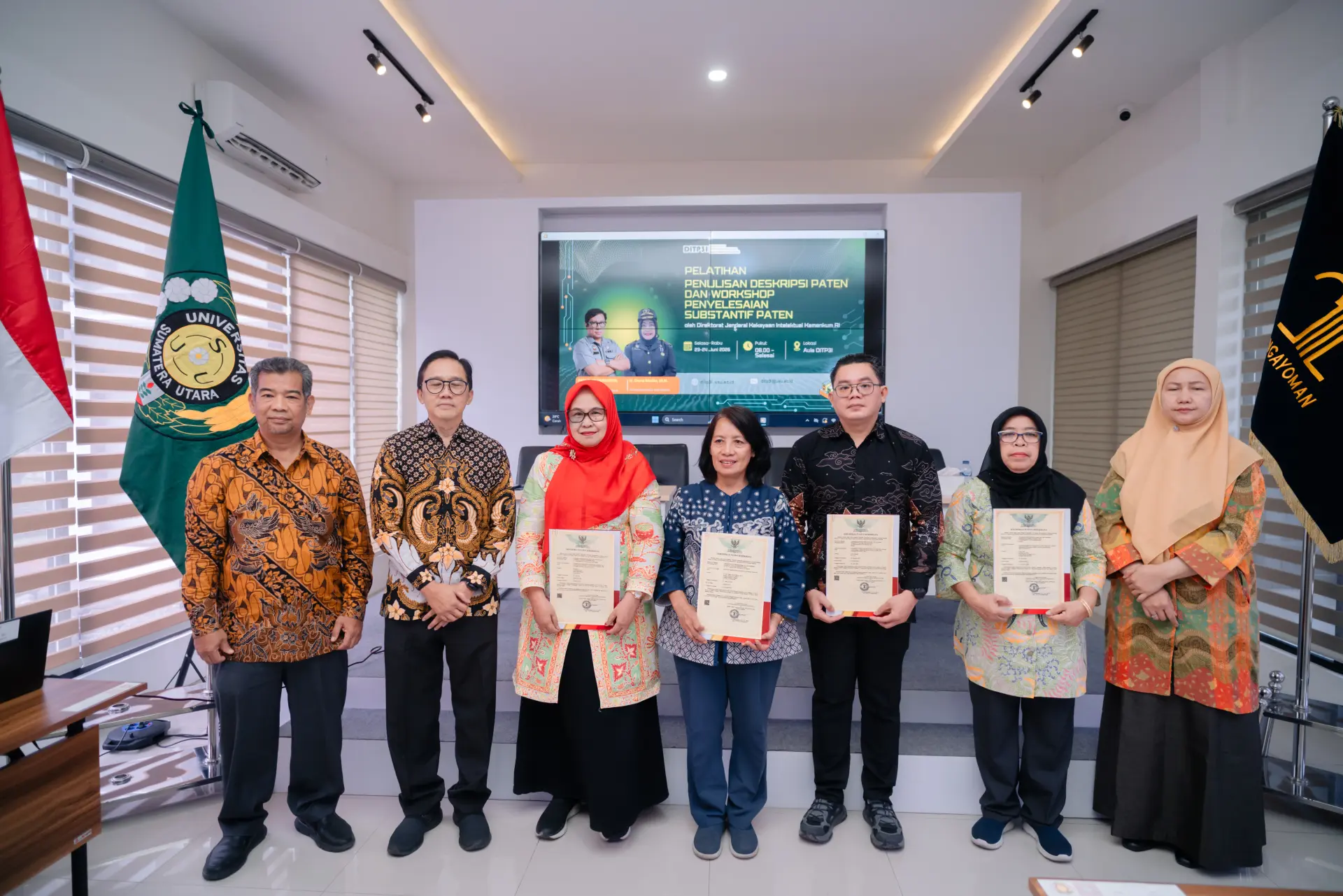
HUMAS FMIPA – The Faculty of Mathematics and Natural Sciences (FMIPA) at Universitas Sumatera Utara (USU) has reaffirmed its commitment to strengthening the culture of research and innovation through active participation in the Patent Description Drafting Training and Patent Substantive Examination Workshop, organized by the Directorate of Scientific Writing, Publication, and Publishing (DP3I) of USU in collaboration with the Directorate General of Intellectual Property (DJKI) of the Ministry of Law of the Republic of Indonesia. The program was held on 23–24 June 2026 at the DP3I Auditorium, USU.
FMIPA USU's participation in the event reflects the high level of research productivity and innovation demonstrated by its faculty members and researchers. During the workshop, several inventors from FMIPA USU received patent certificates for research outputs with significant potential for commercialization and practical applications benefiting both society and industry.
Among the patented innovations were a calcium-rich sardine bone flour production process as a source of macrominerals, a calcium-enriched clam meatball production process, and granules made from sardine bone flour and clay for water filtration to reduce heavy metal concentrations, all developed by Dr. Muhammad Sontang Sihotang, S.Si., M.Si. Other recognized inventions included a polycaprolactone–oil palm boiler ash bionanocomposite for methylene blue degradation by Prof. Dr. Dra. Erna Frida, M.Si., and a nano-herbal formulation of Miconia crenata (Vahl.) Michelang developed by Prof. Dr. Syafruddin Ilyas, M.Biomed.
Additional patented innovations from FMIPA USU included a fermented soursop leaf beverage with hypoglycemic properties and lipid profile improvement developed by Andy Candra, S.Si., M.Si., Ph.D., a method for producing hydrogel from coffee husks by Dr. Diana Alemin Barus, M.Sc., and a body scrub formulation combining cinnamon bark powder and carrot flour developed by Prof. Dr. Elimasni, M.Si. These innovations demonstrate the diversity of expertise within FMIPA and its ability to produce science-based solutions in the fields of health, environmental sustainability, food technology, and technological innovation.
Through the training and workshop, faculty members and researchers received direct mentoring from DJKI patent examiners on preparing patent descriptions that comply with national standards and on addressing substantive patent examination requirements. The program is expected to improve the quality of patent applications and accelerate intellectual property protection for research outputs produced by the USU academic community.
The Dean of FMIPA USU welcomed the initiative as part of the faculty's strategic efforts to increase the number of patents and strengthen the commercialization of research outcomes. The success of FMIPA faculty members in obtaining patent certificates demonstrates that their research not only contributes to scientific advancement but also generates economic and social value that can benefit the wider community.
Looking ahead, FMIPA USU remains committed to fostering a culture of innovation, strengthening research collaborations, and increasing the number of intellectual property assets generated by its academic community. With continued support from the university and the government, FMIPA is confident in its ability to become one of Indonesia's leading drivers of scientific and technological advancement at both the national and international levels, in line with Universitas Sumatera Utara's vision of becoming a research- and innovation-driven world-class university.
HUMAS FMIPA